case Study
The Lab
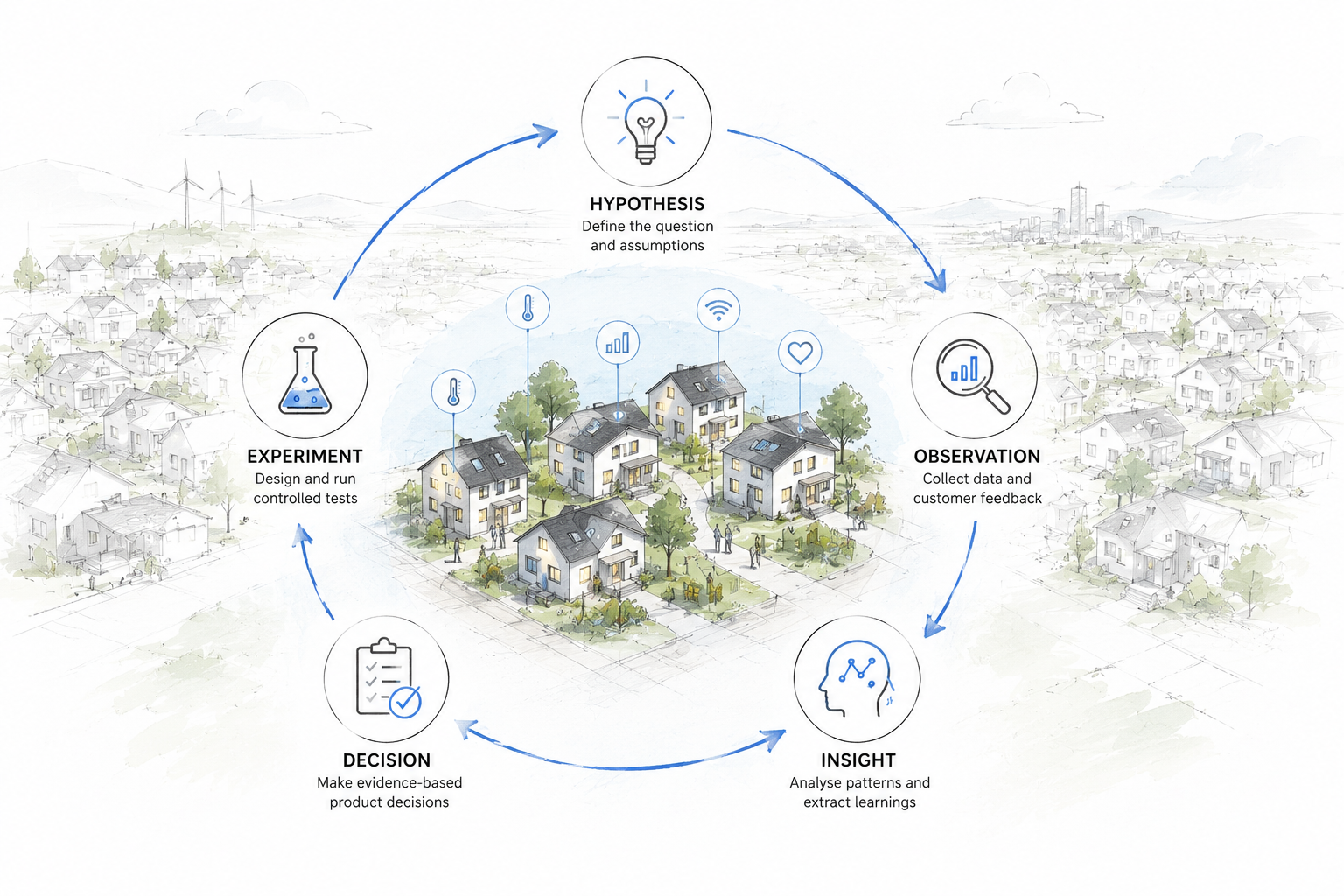
Creating production-like environment to learn faster
-
As the platform grew, decisions became increasingly expensive.
Releasing new features, algorithms, and operational concepts directly into production exposed thousands of households to unnecessary risk. At the same time, waiting for complete certainty slowed innovation and delayed learning.
Teams faced a recurring dilemma:
Should they move quickly and risk being wrong, or move cautiously and risk learning too slowly?
Neither option scaled.
The organisation needed a way to learn faster without exposing the broader customer base to unnecessary uncertainty.
-
A dedicated beta-testing ecosystem was created, bringing together more than 500 highly engaged users willing to participate in structured experimentation.
Unlike standard customer deployments, these users operated with enhanced instrumentation, additional monitoring capabilities, and closer feedback loops.
This created a controlled environment where new ideas could be observed under real-world conditions while limiting operational risk.
The objective was not simply testing software. It was understanding context and behaviour.
-
Ideas were transformed into measurable hypotheses before being released at scale.
The Lab became a validation environment for:
Product features
Customer experiences
Operational processes
Device configurations
Platform behaviours
Experiments were designed around observable outcomes, allowing teams to evaluate adoption, performance, reliability, and customer response before making broader investment decisions.
Discussions increasingly shifted from opinions to evidence.
-
The greatest value of the Lab was not defect detection. It was organisational learning.
Additional instrumentation allowed teams to observe how customers actually interacted with features, how devices behaved under different conditions, and where assumptions differed from reality.
Insights generated through the Lab informed:
Product roadmap decisions
Release readiness assessments
Feature prioritisation
Reliability improvements
Operational design choices
And learning occurred earlier, when changes were still inexpensive.
-
The Lab became the bridge between innovation and industrialisation.
Rather than deploying ideas directly to tens of thousands of users, teams could validate concepts within a representative environment first.
Risk decreased and confidence increased. Product decisions became more evidence-based.
And successful concepts entered production with a much stronger understanding of how they would behave in the real world.
The lasting outcome was not the Lab program itself. It was the creation of a repeatable learning system that allowed the organisation to make better decisions with greater confidence.